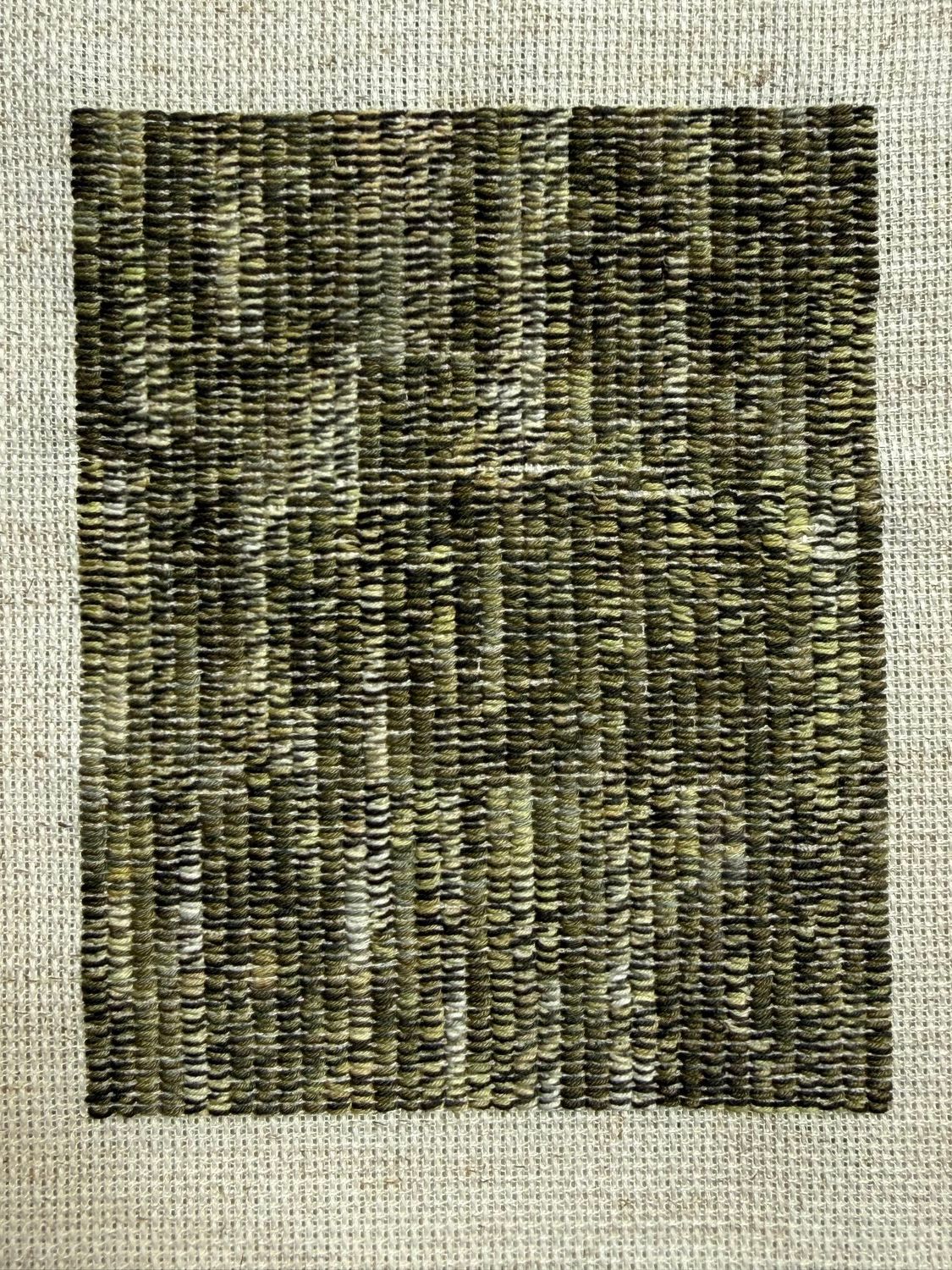
I recently bought a small abstract embroidery.
It is not grand or imposing, but it’s beautiful. It is made from a mixture of yarns, worked through a ground cloth in hundreds of individual stitches. I am having it framed, and it will hang in my hallway.
As with any new acquisition, I’m enjoying getting to know it. I find myself turning it over, looking at the back and noticing where one thread ends and another begins. I look at the changes in colour, the variations in tension and the accumulation of small decisions that have produced the final piece.
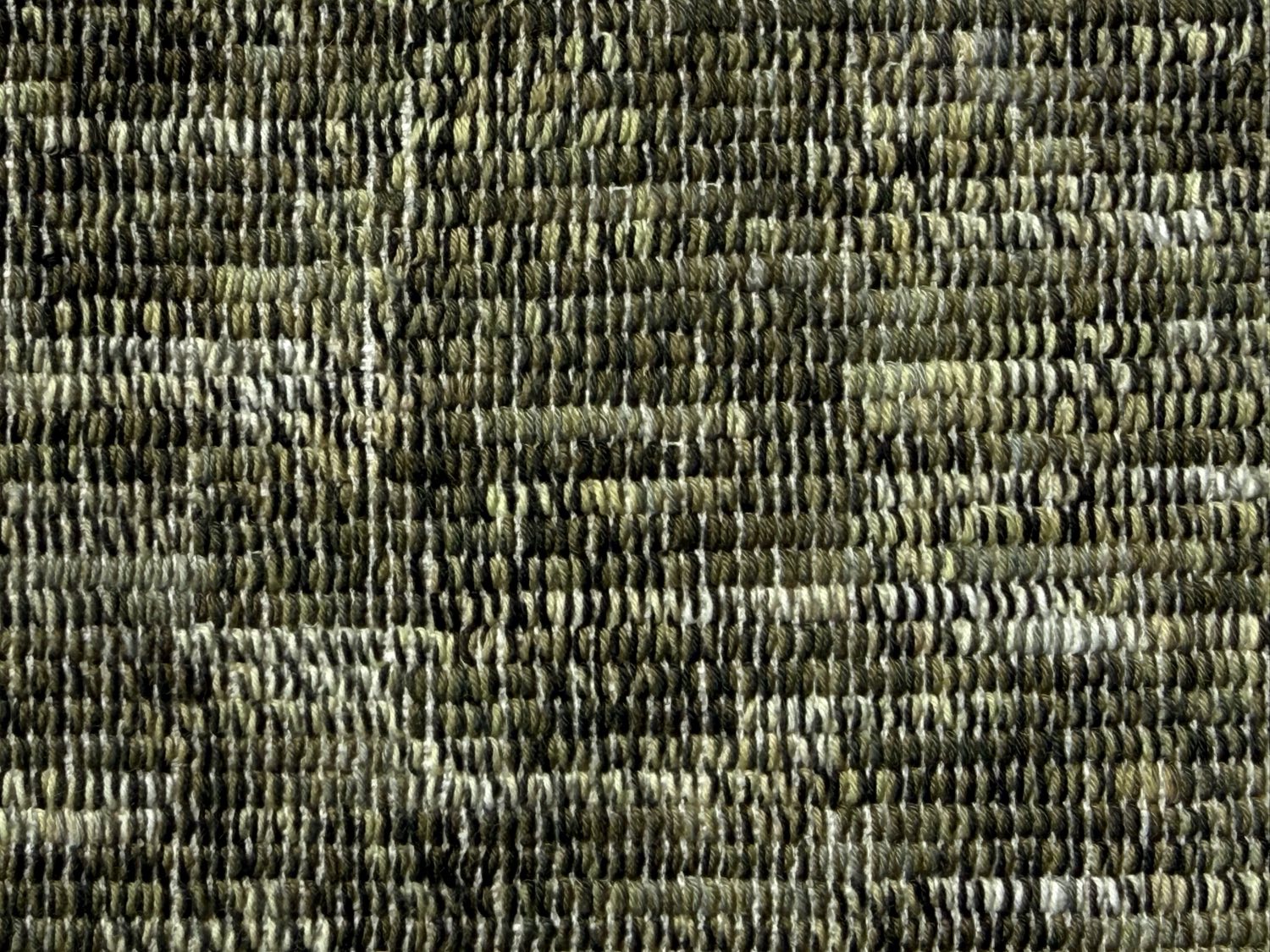
I think about the person who made it. How long they sat working it. How they decided which colour to use next and how this changed through the process. I can see that there was a plan for how the work needed to turn out, but it’s in the selection of colours within a restricted palette that I wonder if they allowed themselves to drift.
This thinking gives me immense joy.
The mark of the maker
Over a decade and more of working in the interior design world, I have attended so many fairs, launches, exhibitions, private views, and talks. I have also visited hundreds of studios, workshops, factories, showrooms and homes. Looking back across all of it, the most significant change I see is not a new style, palette or fashion.
It is a change in what we believe gives an object value.
There has always been a part of the design world that respects craft, materials and the hand of the maker. I have increasingly found my own tribe within that community. I am drawn to craftspeople, artists, designers and artisans who know their materials intimately and whose work carries evidence of how it was made. I think about this as the mark of the maker: the incidental impression of the hand while making something which distinguishes it from being made in a factory.
What now feels different is the scale of interest and the way handmade work is being incorporated into design projects.
From spectacle to the fabric of the home
In the past, craft was often positioned as the great feature of a room: the handmade chandelier, the embroidered headboard, the painted mural or the intricately worked wall covering. It was expected to command attention and, usually, a considerable part of the budget.
Handmade work was treated as the exceptional object and only belonged in the most expensive interiors.
But I know a few furniture makers who produce beautifully considered stools for around £300 to £500. Within the context of a larger interior project, a piece like that can introduce character, material interest and human presence without becoming the principal commission in the room.
The shift I am seeing is from handmade work as spectacle towards handmade work as part of the fabric of the home. It can be a carved detail, a woven textile, a small piece of furniture, or a ceramic vessel. It does not always need to announce itself.
Designers are moving earlier
Designers and clients are also looking more widely. They are visiting fairs, following maker groups online, exploring organisations such as Cockpit Arts, QEST, Crafts Council and many more and paying closer attention to the creative communities around them. They are discovering that craft is not a single narrow luxury category but an extensive and varied ecosystem.
The timing of these conversations has changed too.
I increasingly see designers bringing makers into projects earlier. They are thinking about where a mural artist, woodworker, textile artist or stone carver might contribute before every part of the design has been resolved. They are allowing room for the work to evolve rather than approaching the maker only once the rest of the space is complete.
The change is visible at design fairs. Decorex now presents a tightly edited selection of makers, giving craftspeople access to an interior design audience that might otherwise never encounter their work. I know makers who have said that this exposure opened an entirely new market for them and changed the course of their careers.
I saw the same appetite at ICFF in New York earlier this year. The area dedicated to independent makers appeared, to my eye, to be the busiest part of the fair. Designers were not treating craft as an admirable sideshow. They were actively looking for work, relationships, and collaborations they could bring into future projects.
The lesson from fashion
This movement extends beyond interior design.
Fashion has been going through a similar reassessment. For years, logo mania was the craze. The label often carried more cultural weight than the composition, construction or origin of the object itself.
As people became aware of the gap between production cost, retail price and perceived value, that relationship began to feel increasingly hollow.
The reaction was the rise of quiet luxury. At its most superficial, this became little more than expensive beige clothing without logos. At its best, it introduced a wider audience to the importance of fibres, fabrics, finishes and construction, and to think about an object beyond its aesthetic value.
People began asking what a garment was made from, how it had been produced and why one material felt or behaved differently from another. The emphasis shifted from the logo to the integrity of the craft.
This awareness has shifted into the home.
When you begin to care about the cloth against your skin, it is not that far a leap to care about the fabric on your sofa. You begin to consider the materials you touch every day, the objects you place in front of you and the surfaces that surround you.
This has developed alongside a broader interest in wellness, natural materials and the emotional effect of our environments. People are thinking more carefully about what they bring into their homes, how materials have been chemically treated and how a space makes them feel.
When the world outside feels chaotic, the choices we make at home take on greater significance.
We want calm, but calm does not necessarily mean emptiness. We want to live with things that feel grounding, meaningful and real. We are becoming more deliberate about what we buy, what deserves space and what will continue to matter after the initial thrill of acquisition has passed.
Buying someone’s time
This is where handmade objects become particularly powerful.
The value of my embroidery is not in the materials. Like most artworks, the value lies in the ideas, attention and human time contained within it.
Every stitch requires a separate physical action. Colour cannot simply be spread across the surface. It must be built stitch by stitch, with each area representing another period of concentration and labour.
That thinking changes my relationship with it. I am not simply buying an image. I am buying a portion of someone’s time, thought, experimentation and diligence.
Handmade work asks us to look at objects differently.
A slight irregularity, a change in tension, or an unexpected joint can capture the moment when a person made a decision. I may never meet the person who made my embroidery, but I can see traces of their attention and access something of the process through which the work came into being.
This does not mean that everything handmade is automatically meaningful, original, or well-made. Craftsmanship alone is not a guarantee of quality. Judgement, ideas and skill still matter.
The seismic shift
I believe this is the seismic shift taking place in interior design.
The most compelling interiors I now encounter are those that set out to create a lasting relationship between people, objects and place.
The question is becoming more about whether an object rewards attention. Whether its materials feel considered. Whether it carries the presence of its maker. Whether it will become more important to us as we live with it.
My embroidery will hang in a hallway. I will pass it every day. To me, the value lies partly in the ideas and time it took to make, and my joy is derived from the attention it continues to ask of me.
Frequently asked questions
What is the mark of the maker? The incidental impression of the hand left while something is made: the slight irregularity, the change in tension, the unexpected joint. It is what distinguishes a handmade object from one made in a factory.
Why are handmade objects valuable? Like most artworks, the value lies less in the materials than in the ideas, attention and human time contained in the work. Buying a handmade object is buying a portion of someone’s time, thought, experimentation and diligence.
Does handmade automatically mean better? No. Craftsmanship alone is not a guarantee of quality, and not everything handmade is meaningful, original or well made. Judgement, ideas and skill still matter.
How are designers using craft in interiors now? Less as the single spectacular commission and more as part of the fabric of the home: a carved detail, a woven textile, a small piece of furniture. Designers are also bringing makers into projects earlier, leaving room for the work to evolve alongside the design.