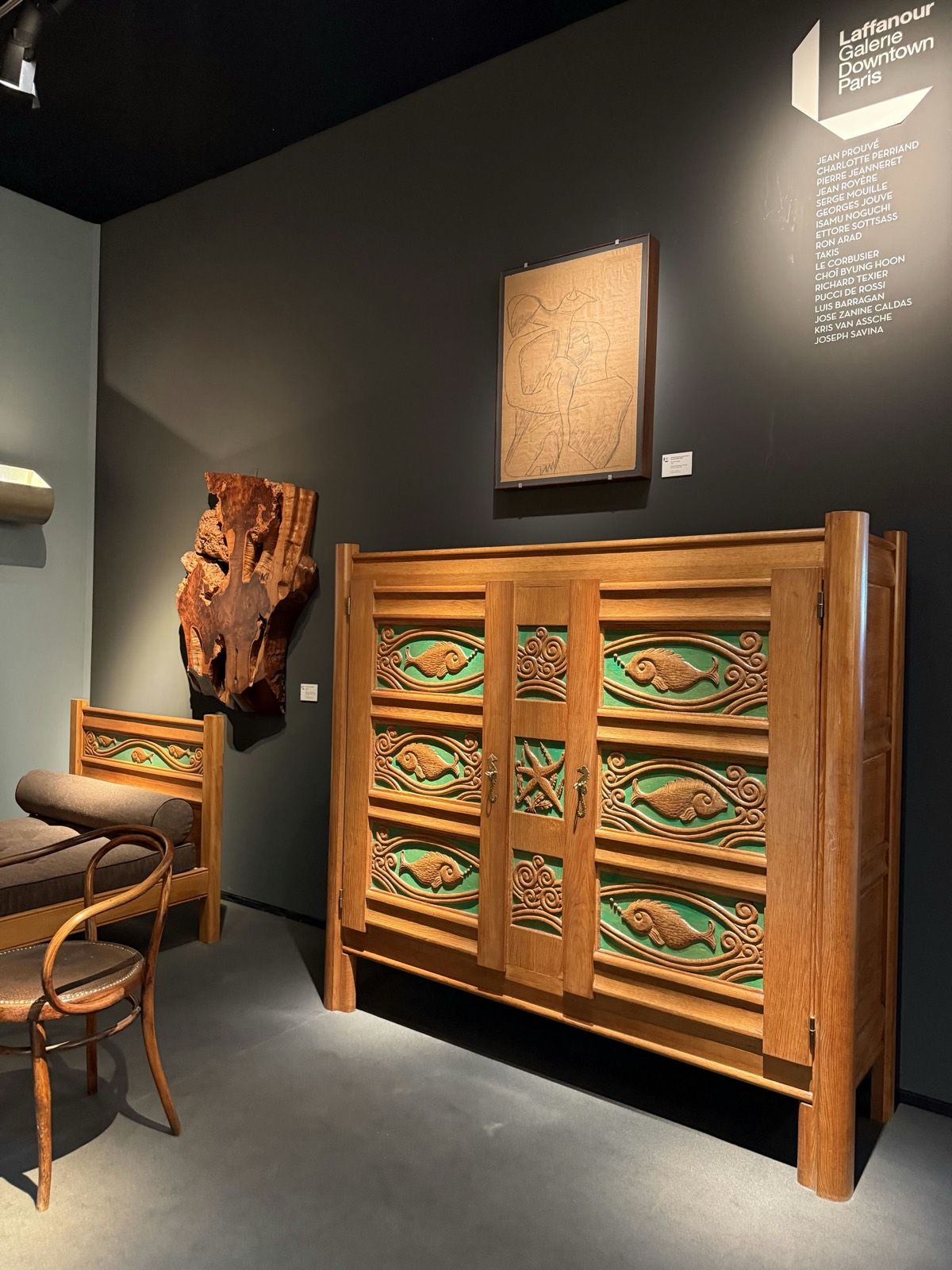
In February 2009, a chair sold in Paris for €21,905,000.
It had two lacquered dragons for arms, and it was made between 1917 and 1919 by an Irish woman who was not yet an architect and who spent much of her working life being described as a decorator. The estimate was two to three million. It went for nearly ten times that, and set a record for twentieth-century decorative art.
Eileen Gray designed buildings too. Most people who can picture the chair could not name one of them.
That inversion runs through everything below. These are women who designed buildings and who also designed the chairs, the lamps and the glassware inside them. In some cases the furniture is what survived. In others, the furniture is what somebody else took the credit for.
Who are the most famous women architects?
Zaha Hadid is the best known, and the first woman to win the Pritzker Prize. Before her came Eileen Gray, Lilly Reich, Aino Aalto, Charlotte Perriand, Lina Bo Bardi, Florence Knoll and Gae Aulenti. All eight built. All eight also designed the furniture, lighting or glassware that went inside the buildings, and in several cases that furniture is the part the market remembers.
What history got wrong, the saleroom is correcting
The pattern repeats often enough to stop being a coincidence. A woman designs a piece of furniture inside a partnership with a man. The partnership gets credited to the man. The piece goes into production under his name and stays there for fifty years.
Lilly Reich co-designed the Barcelona chair. Mies van der Rohe never acknowledged her authorship in his lifetime, and by the time Knoll licensed the chair in 1953 she had been dead six years and could not claim the copyright. Charlotte Perriand had the first LC4 prototype built in her own atelier and upholstered it herself. It is still sold, by most people who sell it, as a Le Corbusier.
The market has been slower to forget than the history books were. Gray’s armchair holds a record. Perriand’s own work now carries her name in the saleroom rather than her employer’s. That is not sentiment or correction for its own sake. It is what happens when the object outlives the argument about who made it, and a buyer has to decide what the authorship is actually worth.
If you collect, that is the useful part. Attribution is not a footnote. It is most of the price.
Eileen Gray, 1878 to 1976
Gray came to architecture through lacquer. She trained in the technique in Paris under Seizō Sugawara, and her early furniture was made for private clients rather than manufacture: one-offs, slow, expensive, and unlike anything else being made.
The Dragons armchair was made between 1917 and 1919 for the apartment of the milliner Suzanne Talbot. Ninety years later it came up in the Yves Saint Laurent and Pierre Bergé sale and made €21,905,000 against an estimate of two to three million.
The architecture came second, and it was good. E-1027, the house she built on the Riviera between 1926 and 1929, is a coded name rather than a serial number: E for Eileen, 10 for the tenth letter, J for Jean Badovici, 2 for B, 7 for G. She designed the furniture for it as part of the building, including the adjustable E-1027 table that is now sold in every design shop in Europe. The Bibendum chair and the Transat came out of the same years.
For a collector the Gray lesson is about category. She was filed as a decorator for decades, which is precisely why the work was undervalued for decades, and precisely why the correction, when it came, was violent.
Lilly Reich, 1885 to 1947
Reich ran her own studio in Berlin and was a serious figure in the Deutscher Werkbund before she ever worked with Mies van der Rohe. They collaborated from the late 1920s, and the German Pavilion at the 1929 Barcelona International Exposition came out of that collaboration, along with the chair it is named after.
The Barcelona chair is sold as a Mies. Recent scholarship argues Reich’s hand went further than the furniture and into the pavilion itself. What is not in dispute is the timing, and Albert Pfeiffer of Knoll International put it plainly: Mies did not fully develop any contemporary furniture successfully before or after his collaboration with Reich.
She died in 1947. Knoll licensed the chair in 1953. There was nobody left to file a claim.
It is the cleanest example of the mechanism in this whole piece. Not theft exactly, and not conspiracy. Just a long silence, and a name on a licence.
Aino Aalto, 1894 to 1949
Read the word Aalto and you probably think of Alvar. Aino Marsio-Aalto was an architect in her own right, and when Artek was founded in December 1935, by the two Aaltos with Maire Gullichsen and Nils-Gustav Hahl, she became its first artistic director.
Her Bölgeblick glassware is the piece most people own without knowing whose it is. Pressed rather than blown, ringed like the ripples a stone makes thrown into water, and stackable, because she was designing for actual kitchens. It took a prize at the Milan Triennial in 1936 and it is still in production.
The interesting thing about Bölgeblick is that it was never meant to be collectible. It was cheap, industrial and useful. That it is now collected anyway is a decent argument for buying the thing that was designed to be used.
Charlotte Perriand, 1903 to 1999
In 1927 Perriand, aged 24, went to Le Corbusier’s atelier and asked for work. He turned her down with a line that has followed him ever since: we don’t embroider cushions here.
She then showed Bar sous le toit at the Salon d’Automne that year, a bar in chrome, glass and aluminium. Pierre Jeanneret brought his cousin to see it. Le Corbusier apologised and hired her.
The chaise longue known as the LC4 came out of the work that followed. Perriand had the first prototype built by a metalworking firm, Hour and Labadie, in her own atelier at Saint-Sulpice, and upholstered it herself in canvas and leather before showing it to Corbusier and Jeanneret. It was exhibited at the Salon d’Automne in 1929. It is still sold under his name.
The record has been corrected slowly, and mostly by exhibitions rather than by the trade. I went to Charlotte Perriand: Inventing a New World at the Fondation Louis Vuitton, which ran from October 2019 to February 2020 and handed the whole of Frank Gehry’s building to one person for the first time. Four floors, eleven galleries, some fifty pieces of furniture, reconstructions of seven of her interiors, and her own photographs hung on the walls beside them.
What stayed with me was how little of it was the Corbusier story. The free-form tables cut like a river bend. The desk she drew for Rio. The low chairs and stools from the 1950s, sitting a foot off the floor because she had been to Japan and come back with different ideas about height. Her photographs of bark and rock next to the tables whose shapes they explain.
None of it reads as an assistant’s work. You cannot walk four floors of that and still call her the woman who was told nobody there embroiders cushions.
Lina Bo Bardi, 1914 to 1992
Bo Bardi trained in Italy and built in Brazil, and MASP, the São Paulo museum of art that opened in 1968, is the reason to know her name. She designed its interiors as well, and did the thing nobody does: took the paintings off the walls and hung them in the middle of the room on glass panels, so a visitor met a picture in open space rather than pinned to plaster.
The Bowl Chair came earlier, in 1951. A hemisphere sitting in a metal ring, designed to let the sitter shift the bowl to whatever angle they wanted rather than the angle the designer chose for them. It went almost unmanufactured for half a century until Arper reissued it. It is in MoMA’s collection.
Both the museum and the chair are the same idea at different scales, which is what you get when the architect designs the furniture: the argument does not change when the object gets smaller.
Florence Knoll, 1917 to 2019
Knoll trained under Eliel Saarinen at Cranbrook and then under Gropius, Breuer and Mies van der Rohe. She was an architect, and she said so whenever anyone described her as a decorator.
The Knoll Planning Unit was her invention, and she was unsentimental about why it existed: the Planning Unit existed because of my background in architecture, she said, and it was the first furniture company that ever had a planning department. It did the interiors for IBM, General Motors, CBS and Seagram. It is not an exaggeration to say she designed the look of the modern American office.
Her own account of her furniture is the best line any designer has given about their own work: I never really sat down and designed furniture. I designed the fill-in pieces that no one else was doing. I designed sofas because no one was designing sofas. She called them the meat and potatoes.
The fill-in pieces are now the most collected thing she made. There is a lesson in that about listening to what designers say about their own output, which is: don’t.
Gae Aulenti, 1927 to 2012
Aulenti worked at both ends of the scale and refused to treat either as the junior job.
At one end, the Musée d’Orsay. She signed the interior architecture of the conversion that turned the gare d’Orsay, a disused railway station, into the museum it now is, in the 1980s. At the other end, the Pipistrello, a table lamp she designed in 1965 for the Olivetti showroom in Paris, produced by Martinelli Luce, with a telescoping stem and an early use of methacrylate for the shade.
The lamp is sixty years old and still in production. Most architects would take either of those. She has both, and the same instinct is visible in each: take a structure that already exists, and make it do something it was not built to do.
Zaha Hadid, 1950 to 2016
Hadid is the exception, and worth including precisely for that. Iraqi born, British, and in 2004 the first woman to win the Pritzker Architecture Prize in the twenty-six years the prize had then existed.
She got the credit. Nobody sells a Hadid building as somebody else’s. And she designed furniture and objects throughout, in the same language as the buildings, from the Liquid Glacial pieces with their apparently poured, frozen surfaces to the Stardune tables.
Which makes her the control in the experiment. When a woman architect is credited properly and in her own lifetime, the furniture is collected as architecture rather than as decoration, and it is priced accordingly from the start. That is the whole difference. It took a century and a Pritzker.
Frequently asked questions
Can you still buy furniture designed by these women? Most of it is still in production under licence. Eileen Gray’s designs are made by ClassiCon, under the world licence held by Aram Designs in London. Lina Bo Bardi’s Bowl Chair was reissued by Arper, Gae Aulenti’s Pipistrello is still made by Martinelli Luce, Aino Aalto’s glassware has never gone out of production, and Knoll has made the Barcelona chair since 1953.
Who was the first woman to win the Pritzker Architecture Prize? Zaha Hadid, in 2004, the first woman named in the prize’s twenty-six-year history to that point.
Which famous women architects also designed furniture? All eight here. Eileen Gray, Lilly Reich, Aino Aalto, Charlotte Perriand, Lina Bo Bardi, Florence Knoll, Gae Aulenti and Zaha Hadid all designed the furniture, lighting or glassware that went inside their buildings.
What is the most expensive piece of furniture designed by a woman? Eileen Gray’s Dragons armchair, made between 1917 and 1919, which sold for €21,905,000 at the Yves Saint Laurent and Pierre Bergé sale in Paris in 2009, a record for twentieth-century decorative art.
Did Lilly Reich design the Barcelona chair? She co-designed it with Mies van der Rohe for the German Pavilion at the 1929 Barcelona International Exposition. He never acknowledged her authorship publicly, and she died in 1947, before Knoll licensed the chair in 1953.
Who designed the LC4 chaise longue? Charlotte Perriand, with Le Corbusier and Pierre Jeanneret. Perriand had the first prototype built in her own atelier and upholstered it herself. It is usually still sold under Le Corbusier’s name.
What this is worth knowing for
If you buy design, the practical point is not the injustice. It is that attribution moves prices, and attribution is still being revised.
Work by women who were credited late, or not at all, spent decades priced as though the credit were settled. Some of that has corrected already, loudly, in Gray’s case. Some of it has not. The names on this list are not obscure, but the specific objects, the Bölgeblick glass, the Bowl Chair, the fill-in sofas, are still bought by people who think they are buying decoration rather than collectible design.
That gap between what a thing is and what it is filed as is where most of the value in this market has always been. It is the same argument as provenance. Who made it, and can you prove it, is not a historical question. It is a pricing one.